

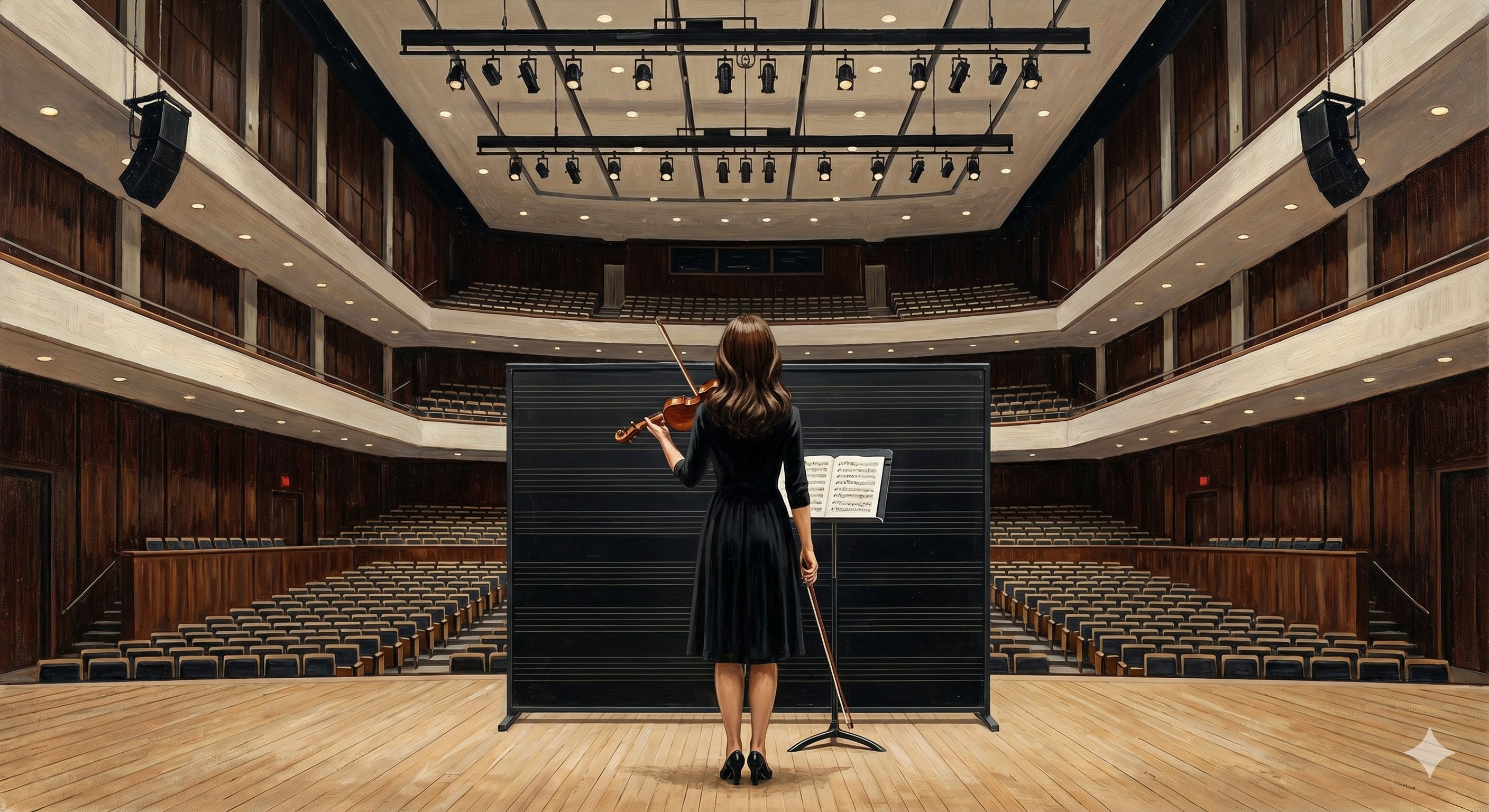
You walk on stage. Pounding heart. Dry mouth. Shaking hands.
You walk into an audition. Pounding heart. Dry mouth. Shaking hands.
Same body. Different problem.
Most performers don’t notice the difference. So they bring performance tools to auditions, and audition tools to performances. Then they wonder why nothing works.
The tools aren’t broken. They’re being used in the wrong room.
A performance is an act of sharing. An audition is an act of asking. The body uses the same alarm bell for both, which is why we get confused. But the problem underneath is completely different.
Figure out which room you’re in. Then you’ll know what to do.
Performance is sharing. Audition is asking.
The audience bought tickets. They drove across town. They arranged childcare. They came because they want you to be great. If you fail, they feel it. So they’re rooting for you the whole time.
The panel didn’t buy a ticket. They have an open seat and a hundred people trying to fill it. Their job today is to filter, not to fall in love. You aren’t entertaining them. You’re applying.
So when you perform, you give. When you audition, you ask.
Giving feels good. Asking feels terrible.
Same body, completely different problem.
The audition is the real fear
A bad performance? You get another shot in the next song. Or Act Two. Or tomorrow night. The show is long, the moments are many, the audience is forgiving.
A bad audition? Silence. Maybe an email in two weeks. Maybe nothing. Just you in the car, replaying every second.
That silence is where the shame moves in. You don’t feel like you executed badly. You feel like you are bad. Like they weighed you and put you back on the shelf.
That’s the real beast. Not the stage. The verdict.
Failure isn’t the same animal either
A bad night of performing leaves you sore. A bad audition leaves you small.
Sore goes away by tomorrow. Small follows you home, into the next room, into the next audition.
Don’t confuse the two. Sore is a body thing. Small is a story you’re telling yourself about who you are.
You can fix sore with rest. You fix small by walking back in and trying again.
Your story about the room isn’t true
You walk in and tell yourself: They’re here to judge me.
You could just as easily tell yourself: They have an empty seat. I’m walking in with a solution.
Neither one is the truth. Both are make-believe.
Pick the one that helps you do the work. Beliefs aren’t facts. They’re tools. Use the tool that fits the job.
A singer I know bombed every audition for a year. Same talent, same room, same songs. She kept walking in thinking “please pick me.” We changed one thing: she started walking in thinking “I have something they’re going to love.” She started booking. The room didn’t change. The story did.
Auditions: the toolkit
Stop performing for the panel. Bring them something.
If you walk in needing them to like you, they feel it. You’re a beggar in their doorway. If you walk in with a strong, specific idea of the work, you’re a guest with a gift.
Rehearse where people can see you. Friends. Family. A camera. Build the muscle of being watched without flinching.
Make a bold choice. Panels will forgive a flaw inside a strong idea. They’ll yawn at a flawless audition that says nothing. Boring is worse than wrong.
Get rejected on purpose. Send your tape to places that say no. Audition for things you won’t get. The more “no” you hear, the less power the word has.
Performances: the toolkit
Breathe out long. Twice as long as you breathe in. Do it twice. Your body will catch up.
Look at your scene partner. Your instrument. The back row. Anywhere but inside your own head. The fear lives in there. Get out.
Decide before you walk on that something will go wrong, and that you don’t care. The aliveness IS the show. People remember the recovery, not the slip.
Whatever scares you, go do it
Both rooms should stay scary. The day they stop is the day you’ve stopped reaching.
The work isn’t to make the fear go away.
The work is to know which room you’re standing in, and reach for the right tool.
Then walk in and do it.